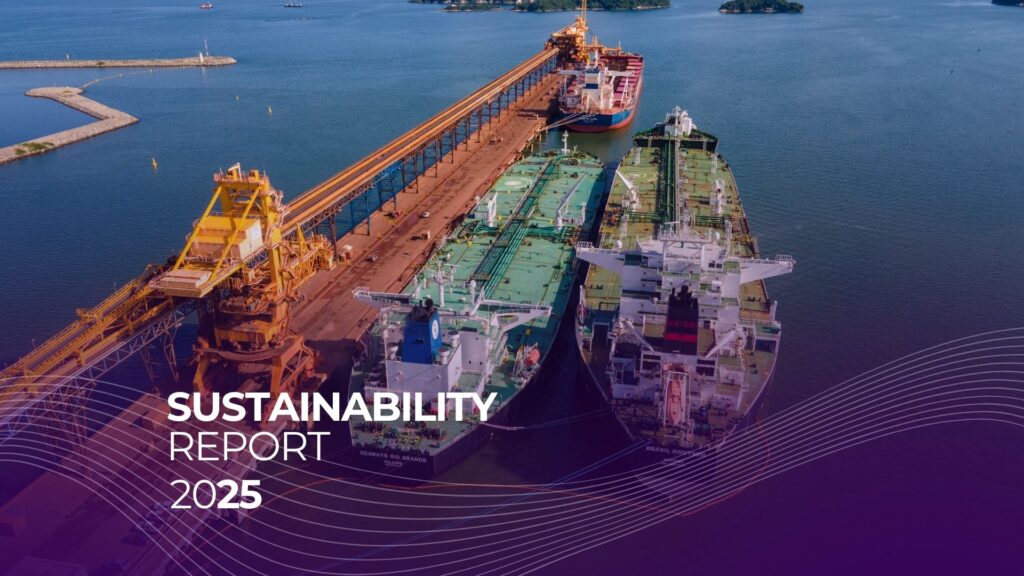
Recognition highlights the terminal’s excellence in emissions management and reflects progress on its Climate Transition Plan, with initiatives focused on decarbonization, risk management, and climate adaptation.
Porto Sudeste has earned the Gold Seal from the Brazilian GHG Protocol Program for the third consecutive year, a recognition awarded to organizations that demonstrate excellence in the management, measurement, and transparent reporting of greenhouse gas (GHG) emissions. The achievement underscores the terminal’s ongoing progress in its climate strategy, which combines emissions reduction, environmental monitoring, and long-term planning for a low-carbon economy.
The port’s journey reflects the steady advancement of its sustainability agenda. In 2022, the terminal received the Silver Seal, and in 2023 it achieved Gold Seal status, maintaining that distinction through 2025. This progression reinforces Porto Sudeste’s commitment to emissions inventory and management practices aligned with leading industry standards.
“A structured approach to emissions management, continuous monitoring of environmental impacts, and the development of a climate transition strategy contribute to a more responsible relationship between port operations and the surrounding community,” says Bernardo Castello, Environmental Manager at Porto Sudeste.
The GHG inventory serves as the foundation for quantifying emissions associated with global warming. It includes the calculation and analysis of the company’s direct emissions (Scope 1), indirect emissions from purchased electricity (Scope 2), and value-chain emissions (Scope 3). This ongoing monitoring has guided the implementation of initiatives that enabled Porto Sudeste to achieve a 76% reduction in Scope 1 and Scope 2 greenhouse gas emissions over the past four years.
As part of the continued evolution of this agenda, Porto Sudeste is also developing a Climate Transition Plan structured around two main pillars: mitigation and risk management and adaptation.
On the mitigation front, the company is building a Scope 3 decarbonization strategy, which includes analyzing value-chain emissions, developing a decarbonization roadmap, setting targets, and evaluating opportunities for emissions-reduction projects. The plan also includes the development of an internal carbon pricing methodology, which will allow the company to assess the cost associated with each ton of CO₂ emitted, initially covering Scope 1 and Scope 2 emissions, with future expansion planned for Scope 3.
In parallel, under the risk management and adaptation pillar, the terminal is conducting assessments of the risks and opportunities associated with the transition to a low-carbon economy. These analyses take into account the characteristics of the markets in which the company operates, as well as industry benchmarks and best practices.
“The Climate Transition Plan represents an important evolution of our sustainability strategy by integrating decarbonization initiatives with the management of risks and opportunities associated with the transition to a low-carbon economy. At the same time, we are strengthening the terminal’s resilience to the physical impacts of climate change, ensuring that our operations are increasingly prepared to respond to extreme weather events in a safe, efficient, and sustainable manner. This is a structured, long-term effort that reinforces our commitment to increasingly responsible operations and preparedness for future challenges,” concludes Porto Sudeste’s Environmental Manager.
* This text has been translated using AI.