Young professionals are proving that those just starting out can also innovate and transform a company’s day-to-day operations.
Whenever something goes wrong in the workplace, the familiar phrase “the intern did it” is never far behind. Repeated almost automatically, it has helped shape a limited perception of young professionals at the start of their careers. In Itaguaí, however, a pair of interns is helping break down that stereotype, showing that even early-career talent can propose solutions that make a real difference in a company’s daily operations.
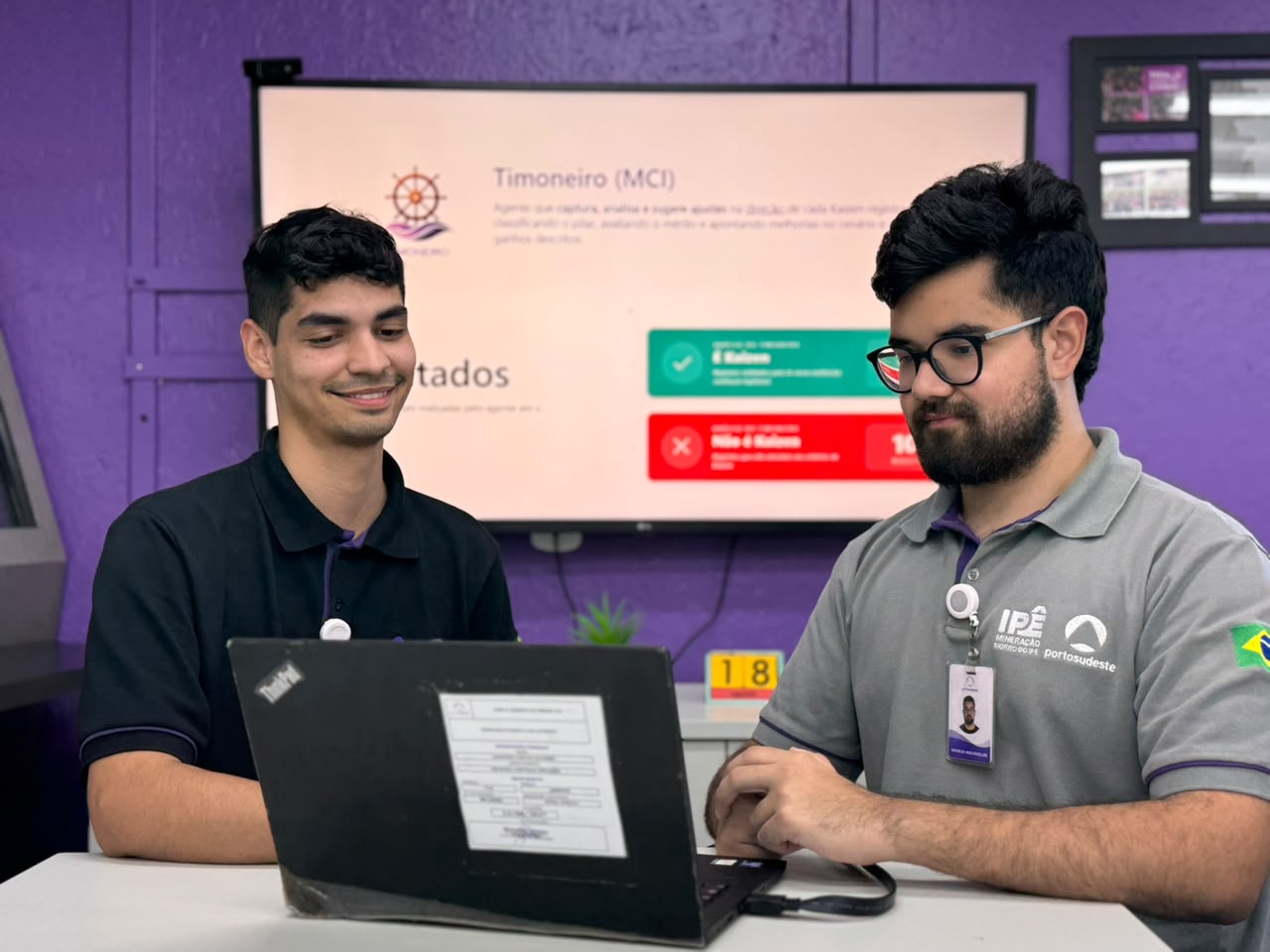
Leonardo Oliveira and Matheus Vasconcelos are part of Porto Sudeste’s Continuous Improvement and Innovation team and worked together to develop a solution to a real operational challenge: evaluating a large volume of ideas submitted to the “Ideias Geniais” Program, an internal initiative designed to foster innovation and operational efficiency.
Within the program, improvements proposed by employees in their daily work are called Kaizens (a Japanese concept meaning “change for the better”). With thousands of submissions received each year, the task of analyzing, categorizing, and validating whether each idea complies with the correct methodology falls to the program’s “ambassadors”, focal points distributed across different departments. Balancing this responsibility with their operational duties, however, meant leaders had to manage an overwhelming number of proposals.
It was in this context that “Timoneiro” was born. The name refers to the professional responsible for steering a vessel, symbolizing the agent’s role in guiding and supporting ambassadors in making methodological decisions, without replacing human judgment.
Implemented in July this year, the AI agent analyzes submissions in real time using a knowledge base built on the company’s guidelines and rules. Within seconds, “Timoneiro” performs a preliminary assessment and delivers a detailed review to the responsible ambassador, indicating whether the proposal meets the criteria of a true Kaizen, recommending the appropriate company pillar (such as Safety, Environment, Productivity, or Governance), and offering practical suggestions to strengthen the idea.
“In practice, “Timoneiro” analyzes the form submitted by the employee and generates accurate assessments. It identifies whether the idea creates a real and measurable impact on the process, recommends the appropriate pillar, and even highlights opportunities for improvement that can make the project more complete. It’s a tool that provides valuable support for ambassadors to make the best decision,” explains Matheus, 20, who joined the company in May.
Leonardo Oliveira, 24, a resident of Itaguaí who has been with the company for three months, adds that Timoneiro neither approves nor rejects projects.
“That decision remains 100% human and rests with the ambassador. Its role is to make our routine easier, ensuring that the Kaizen methodology is respected while providing recommendations that can make each idea even more robust,” he emphasizes.
Since its implementation in July, “Timoneiro” has already processed more than 440 submissions, including 338 validated Kaizens and 105 proposals referred for adjustments. The result has been a significant improvement in response times for employees who submit ideas, while ensuring that proposals are well structured and ready to compete in the program’s annual awards.
“For us as interns, seeing a solution built from scratch create a direct impact on terminal operations is incredibly rewarding,” says Leonardo.
* This text has been translated using AI.