The initiative connected young girls with professionals working in fields where women are still underrepresented, creating a space for dialogue about career choices, challenges, and opportunities.
Port terminals, like many industrial sectors, are still predominantly male environments. Although this reality has been gradually changing, increasing female representation in operational, technical, and leadership roles remains a challenge across the industry.
According to data from Brazil’s National Waterway Transportation Agency (Antaq), women account for 17.8% of jobs in the Brazilian port sector, while in operational roles their participation stands at 10%. At Porto Sudeste, female representation continues to grow each year. The company closed 2025 with women making up 25% of its workforce.
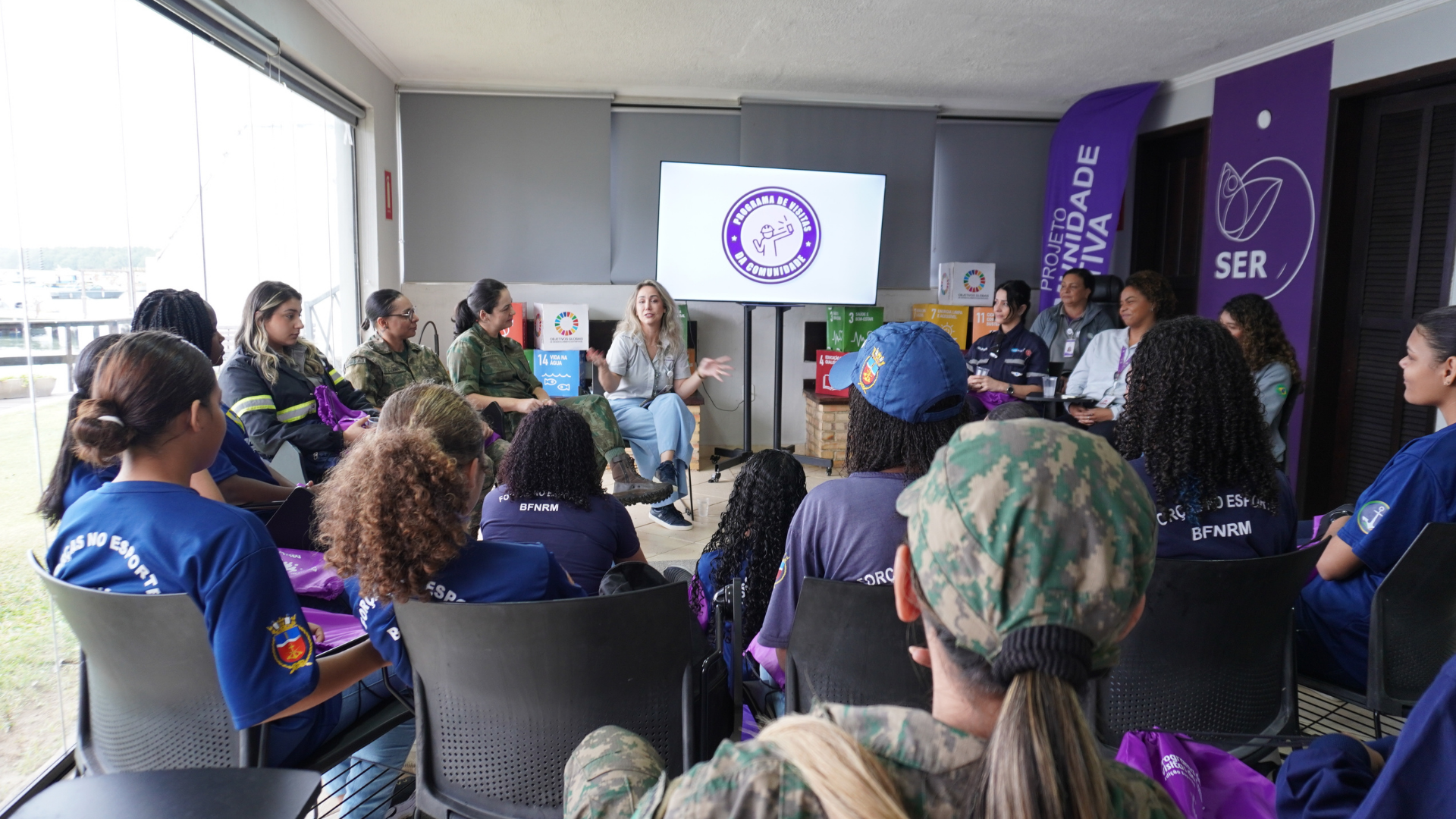
Changes like these do not happen overnight. They depend on access, representation, listening, and often on conversations that help reveal opportunities that may still be unfamiliar to many young women. With this goal in mind, Porto Sudeste welcomed, last Friday (27), a group of girls from Profesp — the Forces in Sports Program, run by the Rio Meriti Naval Marines Base (BFNRM) of the Brazilian Navy, in Duque de Caxias, Rio de Janeiro.
The group, made up of young women aged 14 to 17 from communities in Duque de Caxias, took part in a roundtable discussion with women from different professions, backgrounds, and generations. The meeting encouraged reflection on career choices, the challenges women face in the job market, and the importance of intergenerational exchange.
During the conversation, professionals from a variety of fields—including environmental engineering, firefighting, mechanical technology, and military service—shared experiences from their career journeys. Their stories helped introduce the girls to career paths that are often not part of the initial range of possibilities considered by young women planning their futures.
“When we created this event, our goal was to show what might be possible for young women who are still deciding on a career path. As women who have spent years in the workforce, we can share our experiences and serve as role models. We hope they can become pioneers in whichever fields they choose, without seeing that as a barrier,” said Cintia Santana, Social Responsibility Analyst at Porto Sudeste.
The discussion also addressed the obstacles many women face in breaking family, social, and professional cycles. In one of the testimonies, environmental engineer Daniela Sousa reflected on her own story. The daughter of parents who came from rural areas—her father a factory worker and her mother a domestic worker—she spoke about how each generation can pave the way for the next.
“My parents broke a cycle when they left the countryside and moved to Três Rios, in Rio de Janeiro state. That was a major step forward. From there, I was able to leave Três Rios and move to Itaguaí, bringing me closer to larger urban centers. It is not an easy journey. There are many obstacles, especially when you are a Black woman from a low-income background. Moments like this, when we can hear stories similar to our own from people who have broken patterns and cycles by following different paths, help show that opportunities do exist. Sometimes another woman’s journey opens up a perspective we had never considered before,” she said.
More than introducing different professions, the event created a space for listening, connection, and identification. For the participants, hearing from women working in fields where female representation remains limited was an opportunity to learn about real-life journeys marked by challenges, choices, and achievements. For the professionals, it was also a chance to share lessons learned and reinforce the importance of women supporting one another through conversations about careers, opportunities, and challenges.
The initiative was part of the Extraordinary Women Project, which promotes actions aimed at strengthening female representation, fostering dialogue on equity, and encouraging connections among women from different fields and generations.
* This text has been translated using AI.